It attempts to explore, investigate and imagine the relationship between space and poetry. Questions are asked and some are answered, such as:
What space does a poem create? How does reading a poem affect the way we see/feel a certain space? Can a collective experience of a space be achieved through meditating on the same poetic verse? How does the physical and material place around me affect the way I read a poem? for example, if I read Wordsworth’s Tintern Abbey in a locked, dark room or if I read it in an open, green field, what difference does that have on the poem or on myself, the reader?
Obviously, all of these are valid, interesting questions. They open us to a wide field of possibilities to explore, learn and imagine.
In this blog, I document my project Poetry is Closer than the Sea, and its attempt to answer all these questions. I lean on the thoughts of many thinkers and philosophers, such as Lefebvre, Heidegger, Marx, Deleuze and Guattari.
Theory
In his well-known book The Theory of Space, Henri Lefebvre writes: “space and time are not preconditions for experience, but they are rather experienced”. Such statement shakes the Kantian assumption that Time and Space are a priore; it makes space relative, and endows it with new meanings, beyond those transformed through our five senses.
Deleuze and Guattari offer their contribution to the spatial discussion by connecting space to the Marxist theory. They claim that space is a material abstraction. The capitalist system harnesses and takes over space in an attempt to reign it, tame it, and impose a meaning on it. One example for how authority controls society by annexing space is the one after the recent Arab revolution in 2011, the Egyptian government took over Tahrir Square and built a parking lot on it so to prevent any future protests, but also to disrupt the way people feel about the square as a source of democracy and freedom (this is interesting because the space of Tahrir Square was built through the colonial period in Egypt, and yet it served as the agora of liberation and democracy, that soon was controlled).
Heidegger also offers his contribution to the spatial element of the human experience (the phenomenon, which is distinct from being). In his elaborate mapping of the phenomenon, Heidegger establishes different realms and parts to access the phenomenon, such readiness-at-hand, present-at-hand and equipment. I would have liked to explain his theory more expansively, but I prefer that the reader refers to the original sources, and attempts to understand what does he mean. However, such deep understanding is not necessary to comprehend part of his theory that I’m incorporating in this project. Here is an excerpt to capture what he’s proposing as he talks about the carpenter:
“Phenomenologically speaking, then, there are no subjects and no objects; there is only the experience of the ongoing task. For example, when the carpenter is using the hammer and the nail engaged in work; he is not perceiving/thinking about the hammer in the same way he would if he stepped away and just looked at these equipment. He argues that in this experience, even the carpenter is not aware of himself as a subject.
What I try to do with this project is built on the premise that we’re engaging in the world, we’re looking at the hammer (in our case it would be the images, the poem…) and trying to perceive the phenomenon. In this process, the element of space, which is usually overlooked or perceived as a priore, is experienced. In other words, we’re all the time “in space”; we’re perceiving space as “familiar place” all the time, but at the time of the poem, my intention is to look at space in a more examining way- to look at it as a space, to deconstruct it and investigate it. It’s like when the carpenter stops using the hammer and looks at it.
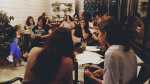
However, the poem is a different entity- it’s printed on the page (physical) and a mental form as it creates a conceptual terrain of its own. Here I try to investigate the space of the poem in people’s hearts through meditation on physical space through questions like if you can describe the poem in a shape, what would it be? what color would it be? what texture?
My aim is to make us conscious about the space using the poem as an equipment. It’s actually reciprocal. We’re aware of the space/place through the poem and aware of the poem by the workshop [the space it creates].


 Poetry is Closer than the Sea