
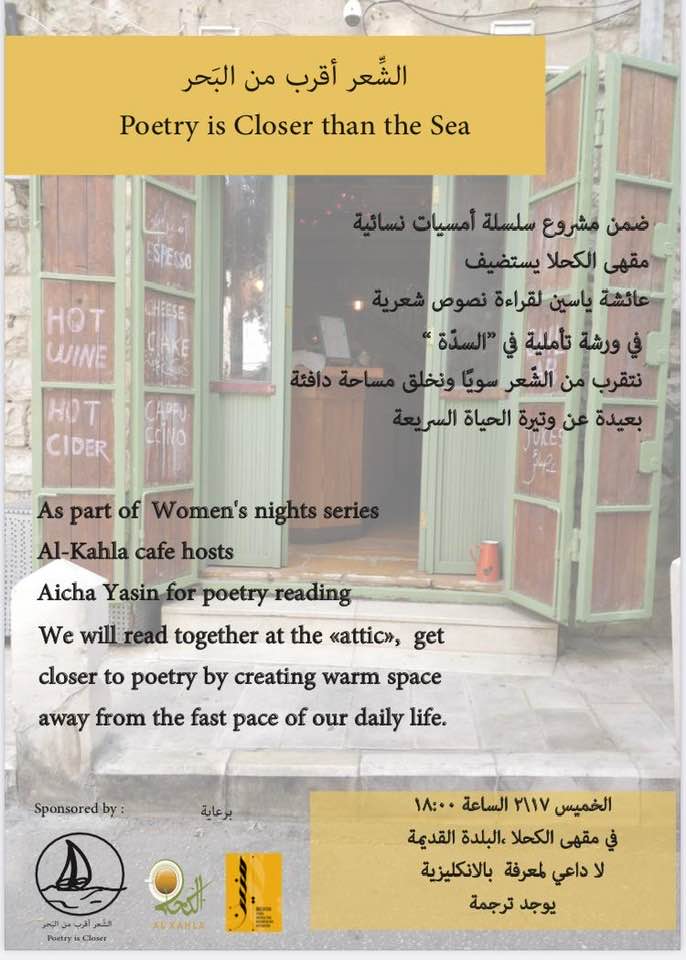
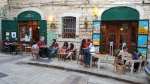
Kahla cafe is a small cafe near Al-Rida restaurant near the Basilica of Annunciation in Nazareth. Kahla means “she with kohl-eyes” (kohl meaning eyeliner in Arabic), which refers to the horse that used to live in that same historic house in which the cafe stands. The owner, Rida Zidani, lost his money and property in gambling, but his horse-kahla- wouldn’t leave the building. The story says that she died out of grief and stubborness not to leave her house. The owner, Razan Zoabi, decided to revive Kahla’s name by founding this cute small cafe. This is not the first time that Razan succeeds in reviving Nazareth history in the old market, for she has founded an architecture cafe located in the heart of the Old Market that aims to preserve the spatial heritage of the city, especially since it’s threatened by the relentless Israeli authorities and blind modernization patterns of the owners of the houses there.
I was invited to have a poety workshop with women only in Kahla cafe. I agreed happily, because Nazareth is my favorite city in Palestine and I know Razan personally.
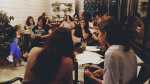
We held the workshop in the attic of the cafe, made tea and served home-made cookies made out of poppy seeds. The poem that I chose for this evening is Naomi Shihab Nye’s “So Much Happiness”. The reasons behind choosing this poem are many: first, I wanted to a poem written by a woman. Second, I wanted an accessible- not too easy but not too complicated, especially since the participants may not be familiar with English poetry. Third, I wanted a deep poem- a poem that makes readers connect and open up, and also that uses literary poetic tools that we can discuss and employ during our session.
It is difficult to know what to do with so much happiness.
With sadness there is something to rub against,
a wound to tend with lotion and cloth.
When the world falls in around you, you have pieces to pick up,
something to hold in your hands, like ticket stubs or change.
But happiness floats.
It doesn’t need you to hold it down.
It doesn’t need anything.
Happiness lands on the roof of the next house, singing,
and disappears when it wants to.
You are happy either way.
Even the fact that you once lived in a peaceful tree house
and now live over a quarry of noise and dust
cannot make you unhappy.
Everything has a life of its own,
it too could wake up filled with possibilities
of coffee cake and ripe peaches,
and love even the floor which needs to be swept,
the soiled linens and scratched records …
Since there is no place large enough
to contain so much happiness,
you shrug, you raise your hands, and it flows out of you
into everything you touch. You are not responsible.
You take no credit, as the night sky takes no credit
for the moon, but continues to hold it, and share it,
and in that way, be known.
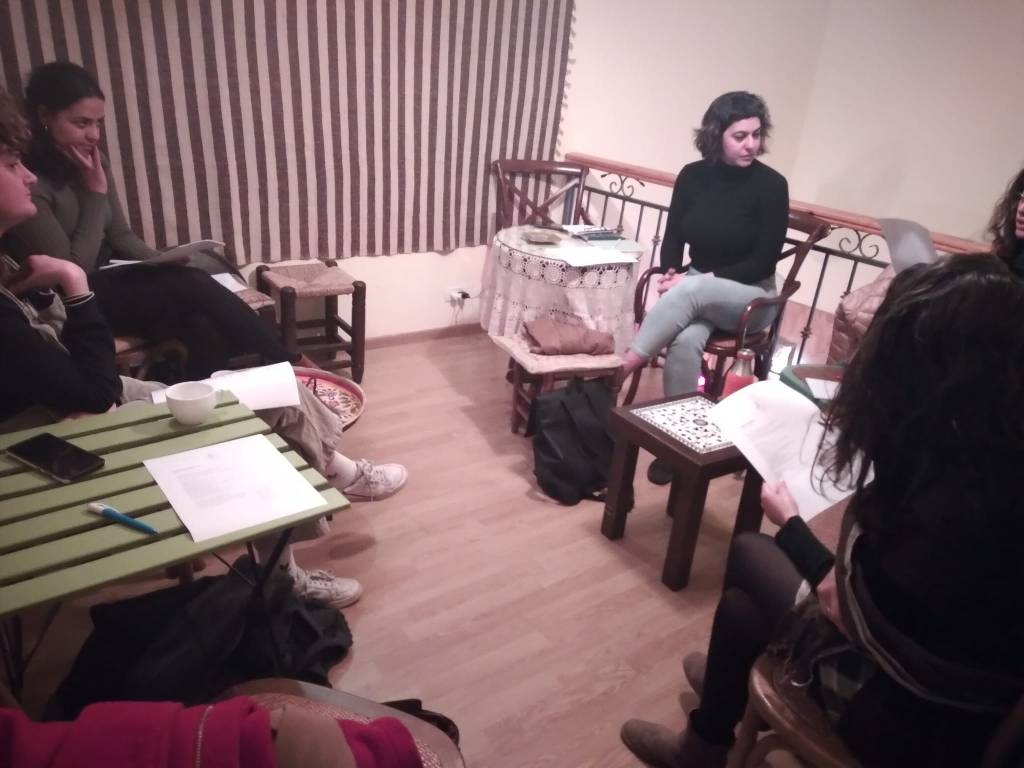
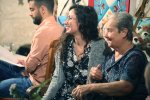
What I loved about this session is that we were able to construct a warm, safe space in the attic, where many participant were encouraged to open up and share their experiences. In contrast to the cold weather outisde, we created an atmosphere together and we pondered together with true honsty and transparency the following questions:
what do we do when we are happy?
what do we do when we are sad?
are we responsible for our own happiness or sadness? Should we react to a feeling or just let it pass us and live the experience?
In addition, I brought a small gift with me for the women who showed up. I brought them a poem in Spanish by the Colombian poet Monique Facuseh (her grandparents are Palestinian immigrants) along with the Arabic translation done by Ahmad Mohsen, a very talented friend of mine. I’m also sharing Monique’s poem along with the English translation and the Arabic translation
A mis abuelos, inmigrantes palestinos. Cierra los ojos. Tal vez por un momento la vida no importe, los años no importen ni sus raras consecuencias. Mírate dentro. Tal vez por un instante goces del placer de quedarte y no tengas que caminar entre la multitud para no escuchar tus pasos. Cierra los ojos y guarda todo el azul o el verde oscuro de la noche. Afuera hay niebla y lobos al acecho. Escucha la lluvia. Pocas cosas bellas quedan. El mundo será peor y tal vez por un momento la puerta sea el callejón donde encontrar la patria. Recuerda que eres rama milenaria. No olvides echarte al hombro tus mandamientos. Pueda que alcances el paraíso. Cierra los ojos. —179— Nacimos perdiendo algo. Delgados hilos nos suspenden. Tras de ti la cruz de tus pensamientos como bandada de pájaros. Mírate dentro. Tal vez por un instante escuches la voz divina y te entregues a su largo exilio. (Del poemario Partitura Cotidiana) | translated by Aicha Yassin To my grandparents, Palestinian immigrants Close your eyes. Maybe for a moment life does not matter Years don’t matter Nor their odd consequences matter. Look inside. Maybe for an instant you will feel the pleasure of staying And not having to walk among the crowds So you will not hear your footsteps. Close your eyes And memorize all the night’s blue And its dark green. Outside, there’s a cloud And anticipating wolves. Listen to the rain. Few beautiful things are left. The world will get worse, And perhaps for a moment The gate will be the alley Where you will find your homeland. Remember that you are a millennial branch. Don’t forget carry your commandments upon your shoulder. Perhaps you will reach paradise. Close your eyes. We are born losing something. Fine strings suspend us. Behind you, the cross of your thoughts like a flock of birds. Look inside. Perhaps for an instant you will hear the divine voice And you will give away yourself to a long exile. | ترجمة أحمد محسن إلى أجدادي، المهاجرين الفلسطينييّن أغلق عينيك ربّما للحظةٍ لا تهمّ الحياة، لا تهمّ السنوات، ولا تبعاتها الغريبة. انظر داخلك، ربّما تنعم لوهلة بلذّة أن تبقى ولا يكون عليك السير بين الحشود لكيلا تسمع وقع خطواتك. أغلق عينيك واحفظ كلّ زرقة الليل أو خضرته. في الخارج ضباب وذئابٌ متربّصة. أنصت إلى المطر بقي القليل من الأشياء الجميلة سيصبح العالم أسوأ وربّما يكون الباب للحظةٍ ذلك الدرب الّذي تجد فيه الوطن. تذكّر أنّك فرعٌ عمره آلاف السنين. لا تنسَ أن تحمل فوق ظهرك وصاياك. يمكن أن تصل إلى الفردوس. أغلق عينيك. لقد وُلِدْنا خاسرين شيئًا. تُمْسِك بنا خيوطٌ رفيعة. من ورائك صليب أفكارك كسرب طيور. انظر داخلك. ربّما للحظةٍ تسمع الصوت الإلهيّ وتسلّم نفسك لمنفاه الطويل |
 Poetry is Closer than the Sea