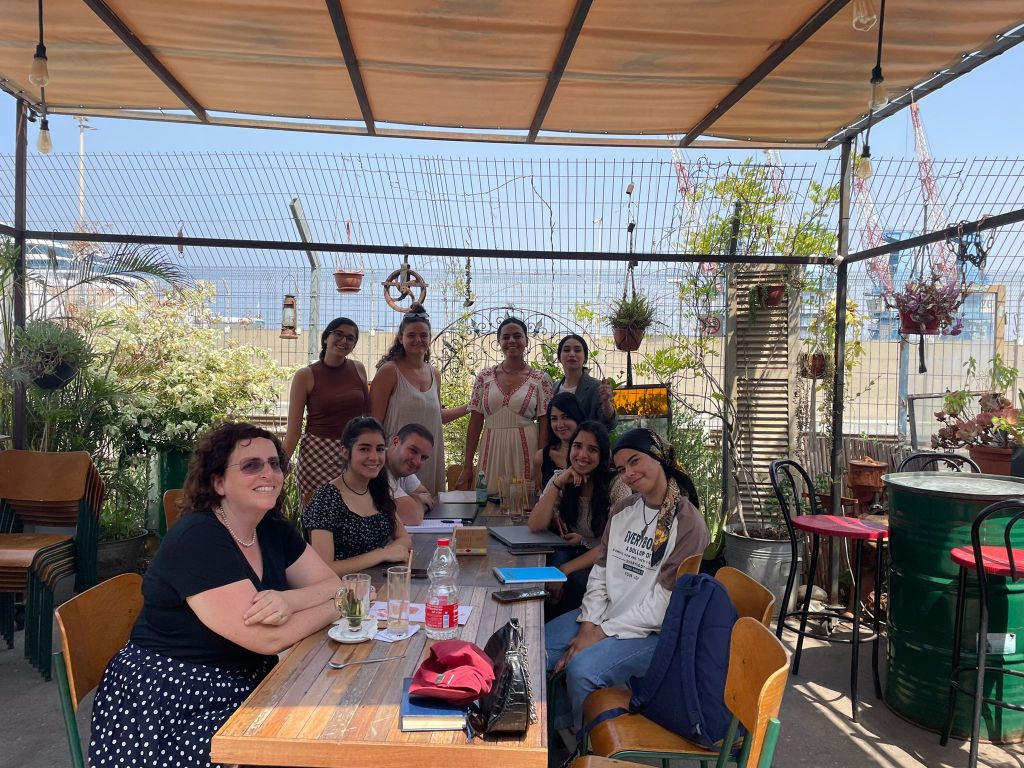
During our first session in the Writing Space, we wrote a lot. I asked everyone to send me their pieces if they would like them to get published here.
I’m sharing Hadeel M’s poem. Hadeel is an English literature student, and she chose this specific major out of passion for both literature and the English language. She loves to read and write and she aspires to become a writer one day.
Hallisa**
Saaed S. and Fatima arrived to Haifa that afternoon
He in his old black car
and she, in her new blue car
She parked in as he did,
right behind his car.
Fatima greeted the soldier as he came to her car
Shaloom Fatima, he said,
they’re friends.
He served in the Army,
with her.
They served in the army,
together.
Fatima glimpsed, then, Saaed S. glances
at the soldier,
She saw the judgment in his eyes,
he looked long at her and the soldier,
standing next to her car.
Saaed S. had lost a child
The soldier had taken away
Saaed’s child.
He’s Fatima’s friend, the soldier.
Saaed left his car and took the ladder next to Fatima’s apartment
to his old house.
Fatima said goodbye to her friend and also took the ladder to her apartment.
Saaed knocked, and she did too.
Shalom, Fatima’s roommate said as she opened the door for her,
and greeted her with hugs and kisses.
shalom? said the lady living in Saaed’s home,
as she looked up and down
the stranger standing at her doorstep
requesting entry
شو حكت هاي؟ (what did she say?)
said Saaed.
The lady is confused
and so is Saaed.
Saaed looked at his own home
which is no longer
his home.
Saaed is unable to enter his home
מי אתה, אדוני? בבקשה תעזוב לפני שאתקשר למשטרה
(who are you, man? Please leave before I call the police!)
Fatima took a final glance at Saaed,
as he took a final glance at his home,
he was short and very old
he looked like Fatima’s father a bit,
he could’ve been Fatima’s father,
he could’ve been someone’s father.
יאללה היכנסי (come on in),
her roommate urged her.
And she did,
as she saw Saaed, right before she closed her apartment’s door, leave.
And Fatima went to her room,
and Saaed to his old black car.
and she watched Saaed S. leave, as she stayed.
But the look she saw in his eyes,
him standing outside his house,
being denied entry,
his final look at his house as he stood beside his car,
never left her.
Fatima sees Saaed S. everywhere now.
She sees him every time her roommate welcomes her home,
and everytime her neighbor
(the one who lives in Saaed’s home)
invite her over to her house,
Saaed’s house.
She sees Saaed in the old Arab man who took the bus with her,
and told her all about his children.
She sees Saaed.
Context:
Fatima and Saaed S. don’t know each other. She guessed who he was judging by the interaction he had with her neighbour and because she is familiar with people coming to their old homes after the Nakba.
The speaker in the poem is an omniscient third party. He knows the events of both the life of Fatima and Saaed S. When Saaed was displaced, his child was killed by the IDF in the midst of the shooting. The character of Saaed is inspired by Ghassan Kanafani’s Saaed S. from Return To Haifa, except the few changes I made as to the fate of his child and the circumstances of his return to Haifa.
The poem discusses both the feelings of Palestinians after the 48′ war, specifically those who were displaced and those who stayed and chose to engage in the new Israeli society. Saaed S. was displaced, and Fatima is now engaged in the society to the extent where she has Jewish friends, lives with Jewish people, and serves in the Army. The poms want to criticize those actions of Fatima by the character of Saaed and by highlighting the differences between them. Fatima lives comfortably in Haifa, while Saaed comes to visit, for example, despite it being the city of both of them.
Saaed’s character also plays the role of an awakening to Fatima, as upon seeing him, she couldn’t stop thinking about him. Fatima now sees him everywhere, as he represents all the Palestinians who lost their homes and children, implying her thinking of other Palestinians whom she never thought of, due to the comfort of her circumstances and the luxury offered to her as a resident under the occupation.




 Poetry is Closer than the Sea