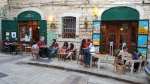
Kahla cafe is a small cafe near Al-Rida restaurant near the Basilica of Annunciation in Nazareth. Kahla means “she with kohl-eyes” (kohl meaning eyeliner in Arabic), which refers to the horse that used to live in that same historic house in which the cafe stands. The owner, Rida Zidani, lost his money and property in gambling, but his horse-kahla- wouldn’t leave the building. The story says that she died out of grief and stubborness not to leave her house. The owner, Razan Zoabi, decided to revive Kahla’s name by founding this cute small cafe. This is not the first time that Razan succeeds in reviving Nazareth history in the old market, for she has founded an architecture cafe located in the heart of the Old Market that aims to preserve the spatial heritage of the city, especially since it’s threatened by the relentless Israeli authorities and blind modernization patterns of the owners of the houses there.
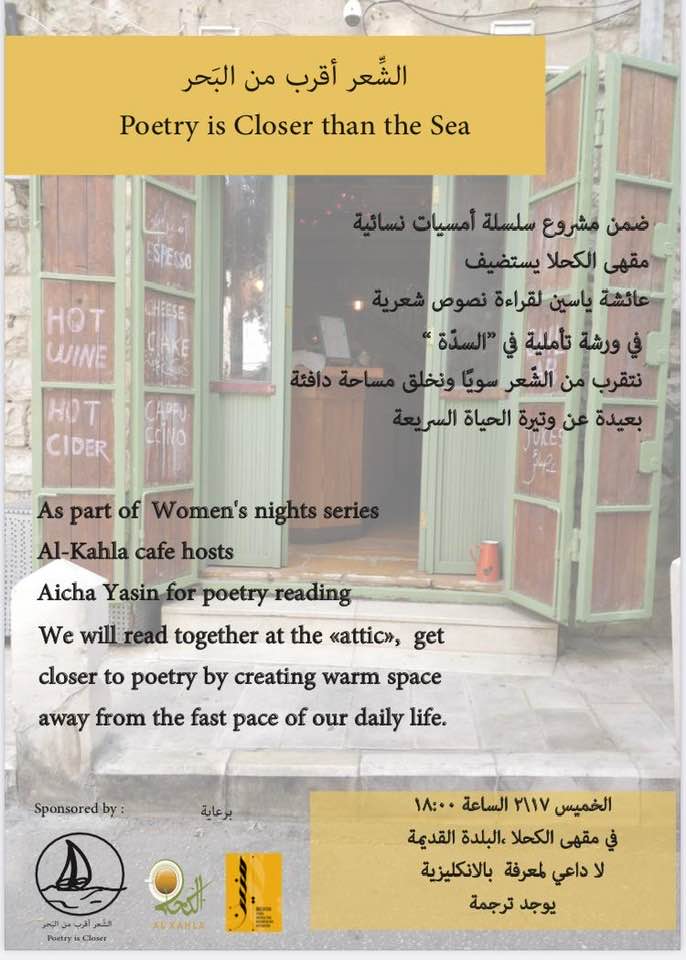
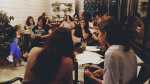
I was invited to have a poety workshop with women only in Kahla cafe. I agreed happily, because Nazareth is my favorite city in Palestine and I know Razan personally.
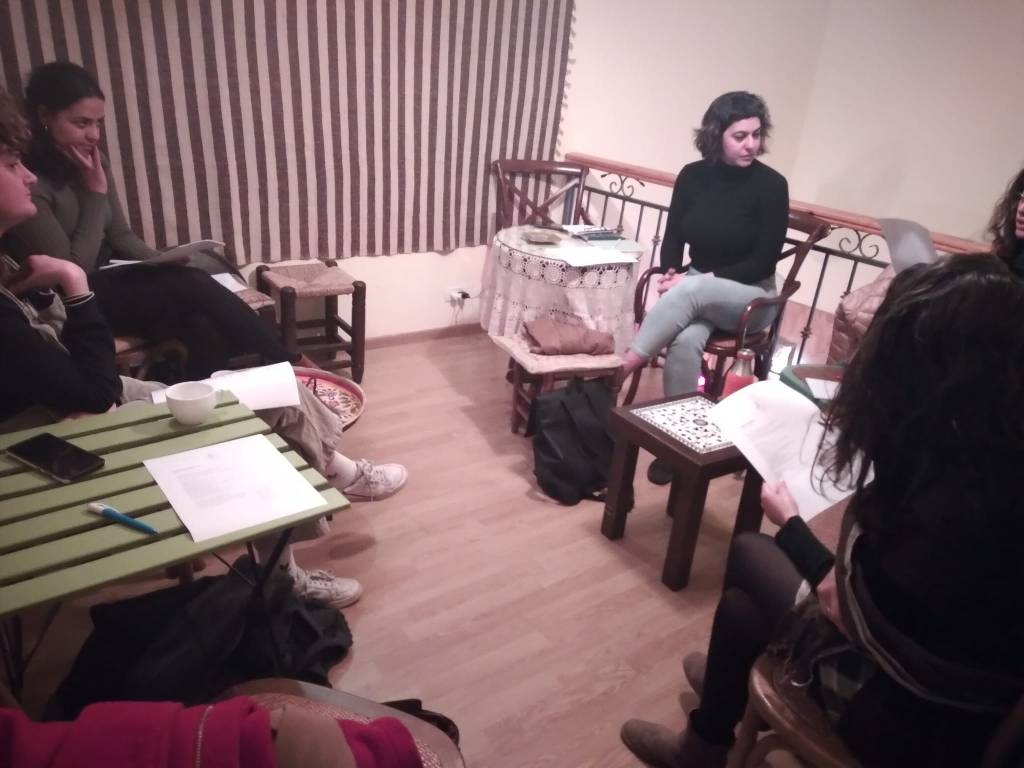
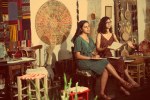
We held the workshop in the attic of the cafe, made tea and served home-made cookies made out of poppy seeds. The poem that I chose for this evening is Naomi Shihab Nye’s “So Much Happiness”. The reasons behind choosing this poem are many: first, I wanted to a poem written by a woman. Second, I wanted an accessible- not too easy but not too complicated, especially since the participants may not be familiar with English poetry. Third, I wanted a deep poem- a poem that makes readers connect and open up, and also that uses literary poetic tools that we can discuss and employ during our session.
It is difficult to know what to do with so much happiness. With sadness there is something to rub against, a wound to tend with lotion and cloth. When the world falls in around you, you have pieces to pick up, something to hold in your hands, like ticket stubs or change.
But happiness floats. It doesn’t need you to hold it down. It doesn’t need anything. Happiness lands on the roof of the next house, singing, and disappears when it wants to. You are happy either way. Even the fact that you once lived in a peaceful tree house and now live over a quarry of noise and dust cannot make you unhappy. Everything has a life of its own, it too could wake up filled with possibilities of coffee cake and ripe peaches, and love even the floor which needs to be swept, the soiled linens and scratchedrecords …
Since there is no place large enough to contain so much happiness, you shrug, you raise your hands, and it flows out of you into everything you touch. You are not responsible. You take no credit, as the night sky takes no credit for the moon, but continues to hold it, and share it, and in that way, be known.
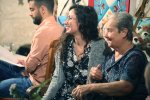
What I loved about this session is that we were able to construct a warm, safe space in the attic, where many participant were encouraged to open up and share their experiences. In contrast to the cold weather outisde, we created an atmosphere together and we pondered together with true honsty and transparency the following questions:
what do we do when we are happy?
what do we do when we are sad?
are we responsible for our own happiness or sadness? Should we react to a feeling or just let it pass us and live the experience?
In addition, I brought a small gift with me for the women who showed up. I brought them a poem in Spanish by the Colombian poet Monique Facuseh (her grandparents are Palestinian immigrants) along with the Arabic translation done by Ahmad Mohsen, a very talented friend of mine. I’m also sharing Monique’s poem along with the English translation and the Arabic translation
A mis abuelos, inmigrantes palestinos. Cierra los ojos. Tal vez por un momento la vida no importe, los años no importen ni sus raras consecuencias. Mírate dentro. Tal vez por un instante goces del placer de quedarte y no tengas que caminar entre la multitud para no escuchar tus pasos. Cierra los ojos y guarda todo el azul o el verde oscuro de la noche. Afuera hay niebla y lobos al acecho. Escucha la lluvia. Pocas cosas bellas quedan. El mundo será peor y tal vez por un momento la puerta sea el callejón donde encontrar la patria. Recuerda que eres rama milenaria. No olvides echarte al hombro tus mandamientos. Pueda que alcances el paraíso. Cierra los ojos. —179— Nacimos perdiendo algo. Delgados hilos nos suspenden. Tras de ti la cruz de tus pensamientos como bandada de pájaros. Mírate dentro. Tal vez por un instante escuches la voz divina y te entregues a su largo exilio. (Del poemario Partitura Cotidiana)
translated by Aicha Yassin To my grandparents, Palestinian immigrants
Close your eyes. Maybe for a moment life does not matter Years don’t matter Nor their odd consequences matter.
Look inside. Maybe for an instant you will feel the pleasure of staying And not having to walk among the crowds So you will not hear your footsteps.
Close your eyes And memorize all the night’s blue And its dark green. Outside, there’s a cloud And anticipating wolves.
Listen to the rain. Few beautiful things are left. The world will get worse, And perhaps for a moment The gate will be the alley Where you will find your homeland. Remember that you are a millennial branch.
Don’t forget carry your commandments upon your shoulder. Perhaps you will reach paradise.
Close your eyes.
We are born losing something. Fine strings suspend us. Behind you, the cross of your thoughts like a flock of birds.
Look inside. Perhaps for an instant you will hear the divine voice And you will give away yourself to a long exile.
ترجمة أحمد محسن إلى أجدادي، المهاجرين الفلسطينييّن
أغلق عينيك ربّما للحظةٍ لا تهمّ الحياة، لا تهمّ السنوات، ولا تبعاتها الغريبة. انظر داخلك، ربّما تنعم لوهلة بلذّة أن تبقى ولا يكون عليك السير بين الحشود لكيلا تسمع وقع خطواتك. أغلق عينيك واحفظ كلّ زرقة الليل أو خضرته. في الخارج ضباب وذئابٌ متربّصة. أنصت إلى المطر بقي القليل من الأشياء الجميلة سيصبح العالم أسوأ وربّما يكون الباب للحظةٍ ذلك الدرب الّذي تجد فيه الوطن. تذكّر أنّك فرعٌ عمره آلاف السنين. لا تنسَ أن تحمل فوق ظهرك وصاياك. يمكن أن تصل إلى الفردوس. أغلق عينيك. لقد وُلِدْنا خاسرين شيئًا. تُمْسِك بنا خيوطٌ رفيعة. من ورائك صليب أفكارك كسرب طيور. انظر داخلك. ربّما للحظةٍ تسمع الصوت الإلهيّ وتسلّم نفسك لمنفاه الطويل
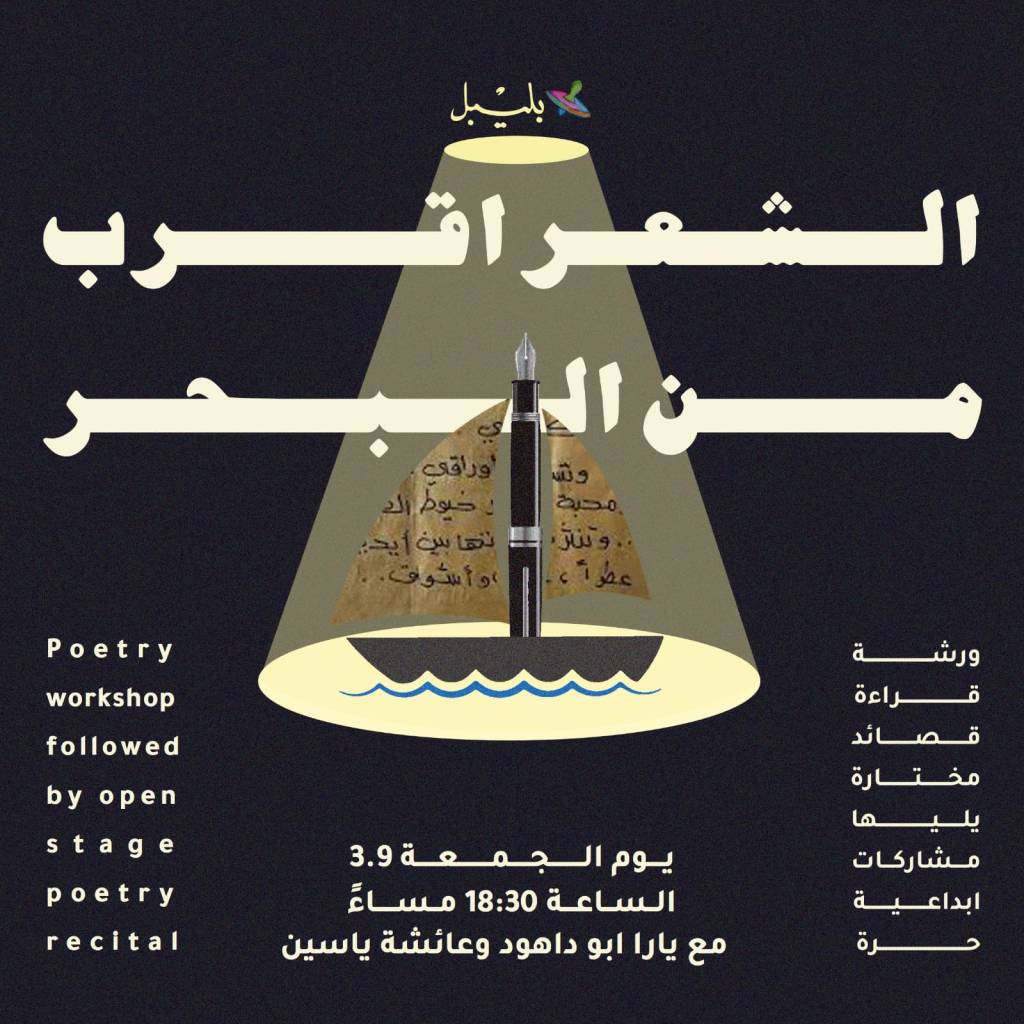
We gathered in Blebel Youth Center in the old market of Nazareth. It’s the 3rd of September, 2021 and the weather is hot bordering cool, especially as the sun sets down and only the cold breeze saved in between the limestone blocks that shape the old alleys of Nazareth’s Market. People gather in Sibat al Sheikh, not only for our event tonight, but also for another event in Baladna- another youth center next to Blebel. As we say in Arabic, الخير خيرين- the more the better! I am really happy to see many people- young and old, from Nazareth and from towns around it gathering for cultural events in the heart of the city.
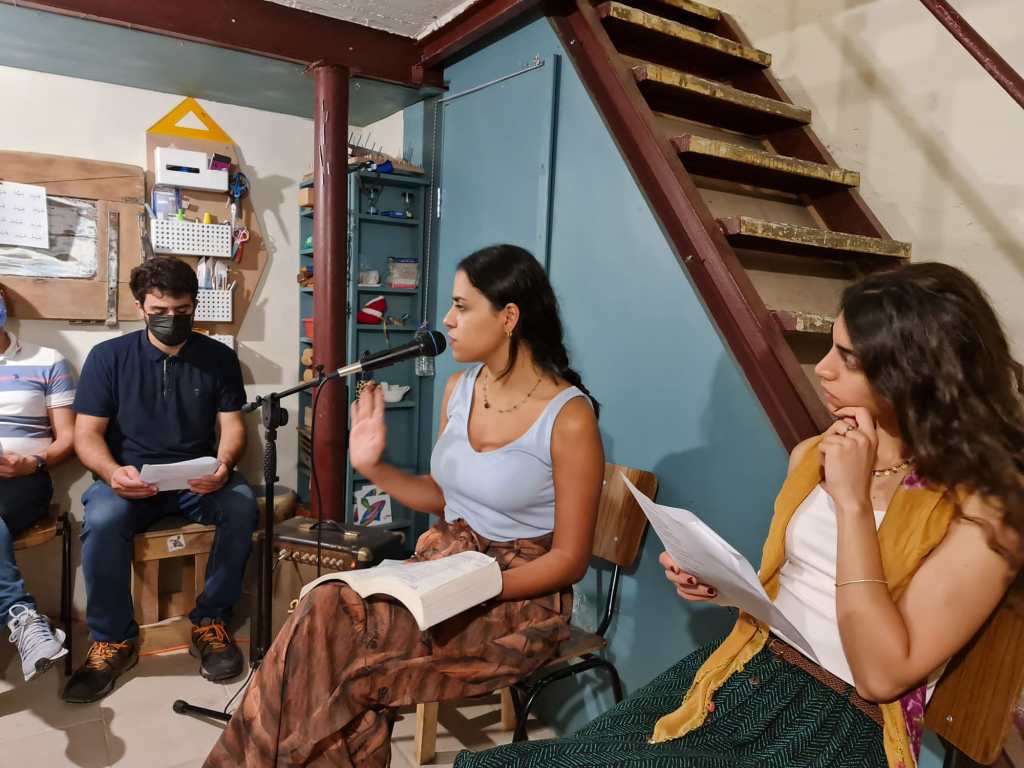
Yara and I. I’m reading Ted Hughes’s poem.
We arrived a bit early to organize the venue, to prepare for the tea and set up the chairs. Though we said we will start at 18:30- we ended up starting at 19. We introduced the project and then ourselves. Then we embarked on the poetic trip that Yara took us by analyzing a poem called “funeral” by a local Syrian-Palestinian poet called Yaser Khinjar from Mijdal Shams. The poem started out to be a bit dark, as its title implies, but then we succeeded in gleaning some hope out of it- in the rebirth that death entails.
At 8, we took a 15-min break to sip tea and eat home-made Mabroushe. It was perfect. I met new persons interested in literature and science and everything in between. I met musicians. I met a friend’s dad and another’s brother! It was beyond me.
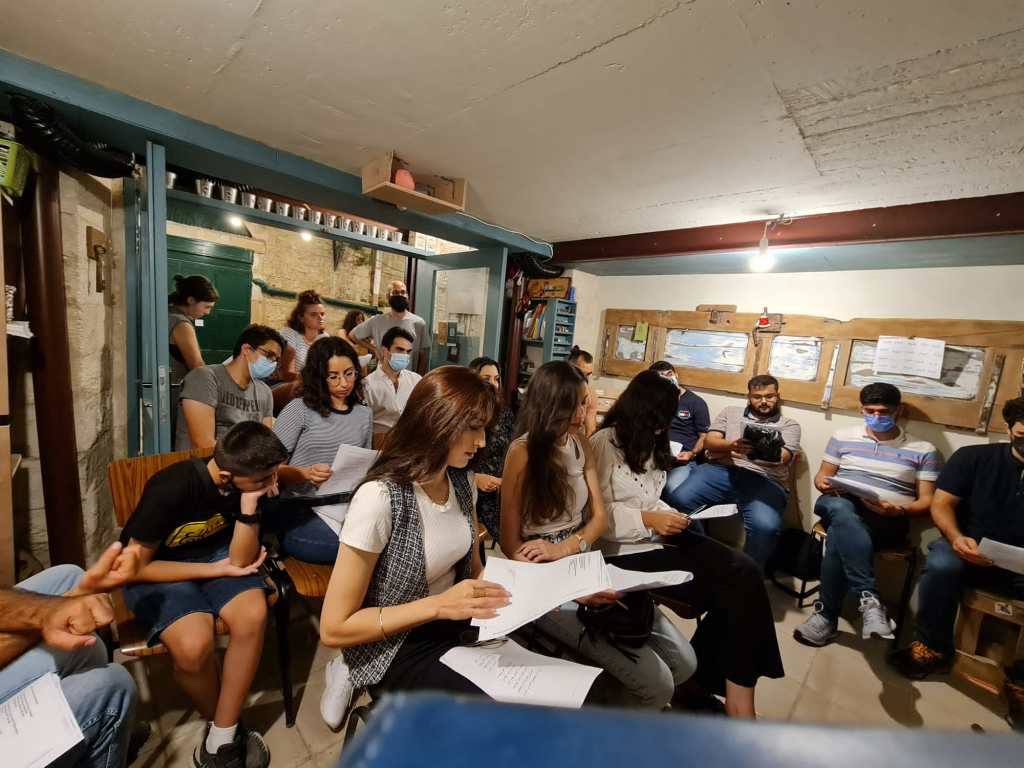
participants in Blebel Youth Center, Nazareth.
After that, we entered the small youth center, keeping the doors wide open so people can still stand outside and follow with the workshop. I presented a dear poem to my heart called “daffodils” by the English poet Ted Hughes. The poem is not easy, and it has many difficult words – especially for a non-native English speakers. I provided the meaning of the words I deemed particularly hard in the hand-out paper. The interactions of the audience was amazing- everyone participated in the discussion that I facilitated in order to understand the poem. At the end, I provided a context of who is the poet and who is his deceased wife- Sylvia Plath.
After we finished analyzing the second poem, we opened the stage for everyone to share their writing or piece of art. This part was amazing and my all-time favorite: the first participant named Abed Al Hamid recited a pre-islamic poem that he memorized by heart. His performance was amazing and he enchanted us all- I felt like I travelled in time to visit Majnoon Layla and listen to his yearnings and longings. Then we had another particpant reciting an traditional-rhymed Arabic poem that he wrote- believe me it’s not easy to write according to the Arabic meteric seas of poetry and he did that splendidly. His name was Ahmad. The third participant read a poem that she is personally fond of, which was when I look at clouds by William Wordsworth. The fourth participant was Yara and she read and performed two amazing poems. Then it was my turn and I shared two very dear to my heart poems. At the end, Shaden’s brother, who is 11-years old came up and recited a poem he wrote about autumn.
The whole experience was breath-taking. Although I had my initial reluctance about having this workshop because I am going through a period of stress and pressure. But this workshop has given me more than it had required efforts from me. Seriously- seeing old and new friends discussing poetry- reclaimging the space of the old market of Nazareth was so powerful and it provided me for so much energy for many projects and initiatives to come. I still have my artistic and philosophical questions about the role of space in this workshop- what did our presence there reading poetry affect the materialistic space and how did the space of the market influence our own poetry reading phenomenon. These questions will accompany for the next few years and I will struggle with them perhaps, the struggle is good – it means progress. So I’m taking my time and not jumping to conclusions. So sorry I can’t provide you with any solid thesis at this stage- I’m only observing, meticulously observing and experiencing and writing.
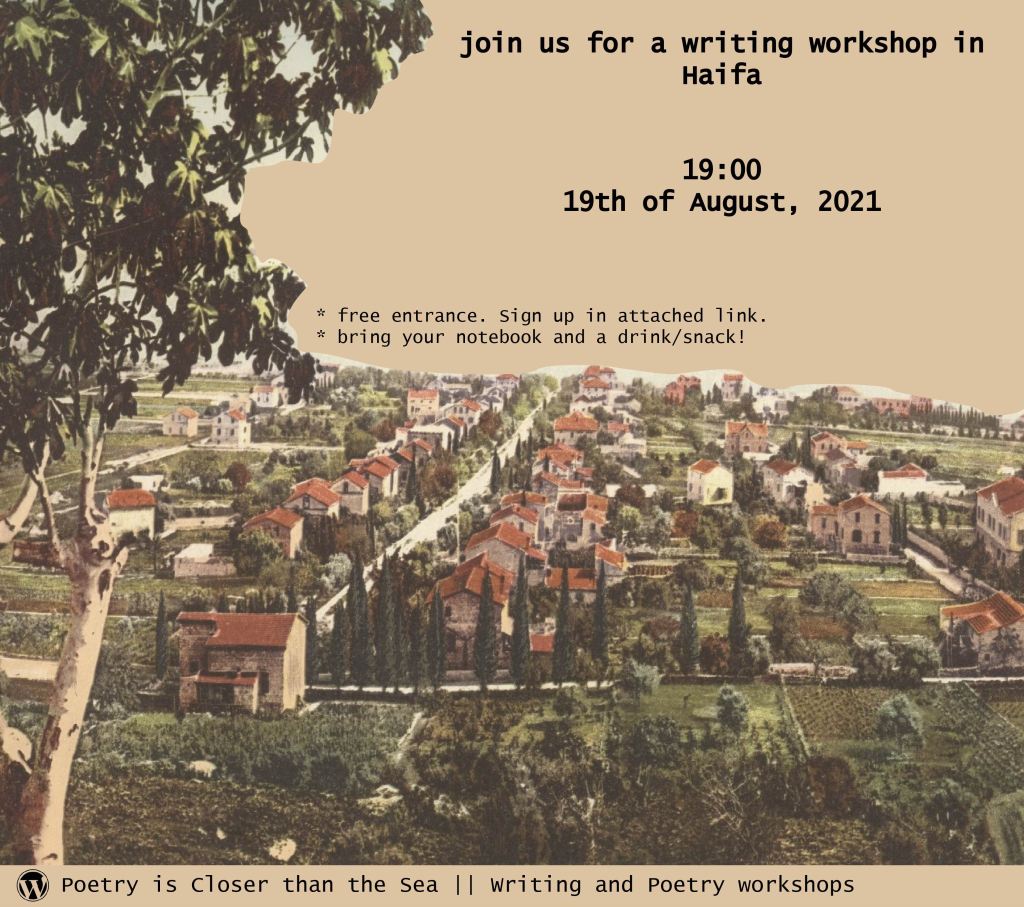
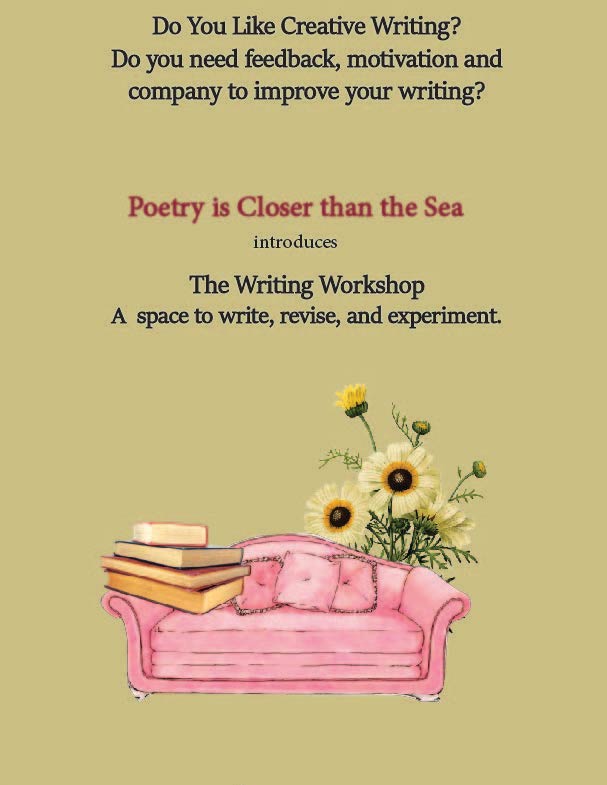
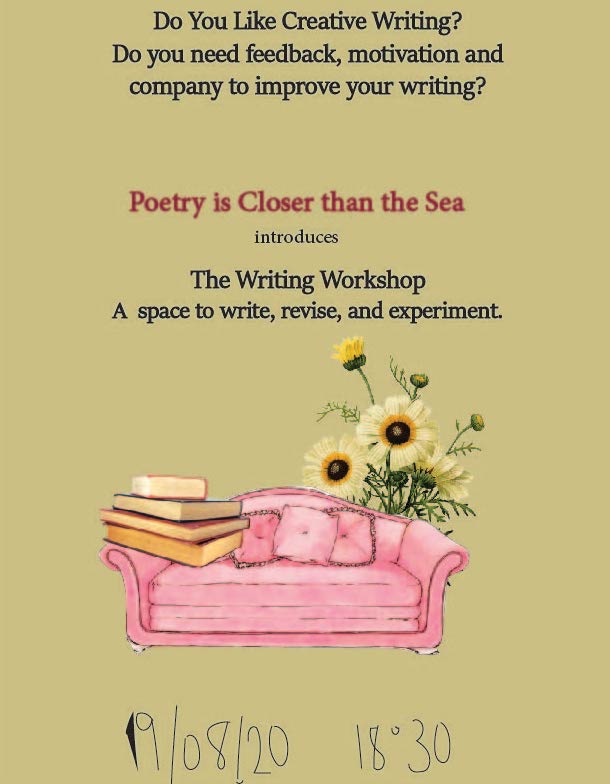
This Thursday (19th of August, 2021), we met on the roof in Masada st 38 in Haifa. We talked, got to know each other and did writing exercises that I’ve prepared earlier. We did 4 writing exercises: 1- stream of consciousness (writing for 7 minutes without stopping). 2- describing a space through smells, sounds and visuals. 3- intense physical [re]experience. 4- write a love poem to an object in your life.
The warmth and coziness of the gathering prompted me to write profusely and without stopping. It was really amazing and everyone felt comfortable and in their zone. We happened to be 8 women in the workshop, because other guys couldn’t make it. And this helped with the warmth of the ambience.
I’m attaching the reading excerpts we used to get our minds to warm up for writing:
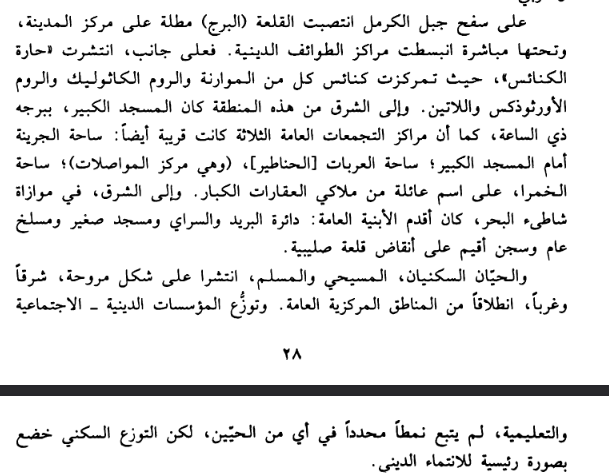
مصدر: حيفا العربية 1918-1937 – مي ابراهيم صيقيلي
on top of the Carmel mount a fortress is built, which overlooks the city center. Beneath the hill, stretch the religious centers. On the side, lies the Churches neighborhood (haret al kanayes), where we find the Maronite, Catholic and Orthodox church. On the east of this point, we find the big mosque with its clock tower. In addition, near by lie the three public centers: Al Jureneh square in front of the Big Mosque; the Carriages square (Al Hanateer square) and Al Khamra squre, named after a wealthy local family. On the east, parallel to the beach, the oldest public buildings stand: the mail office, the Saray, a small mosque, a slaughterhouse, and a prison built on an old crusade fortress.
Ten days ago, on the 28th of Sep, we met via the Zoom program to write and revise our writing pieces together. There were 9 of us and 7 persons shared a piece that they wrote. The writings that we discussed is various including poetry, a novel introduction and a short story, and it included writing in Arabic and in English This fact made it a bit harder to give a professional feedback, because my speciality is English poetry. In other words, I’m more comfortable to give a more practical and useful advices about English poetry and less about prose or a novel. However, the space that I provided for myself and others enabled these ambitious authors to hear what people think or perceive when they read each piece.
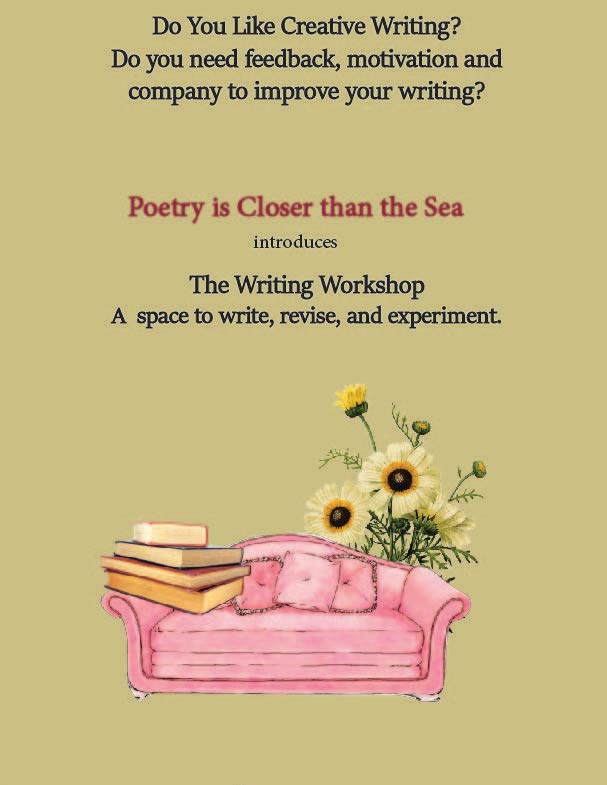
The writing workshop caption
At the end of the 2 hour long workshop, I received their contact info so I can send the writing prompts and the list of books and authors that was formed by the various suggestions in the introduction of the workshop.
Here is the reading list and the writing prompts:
Writing Prompts:
how do you familiarize yourself with something/somewhere/someone?
– try to dramatize the sunset or the sunrise!
– Explore the liminal space of identity: what are your different identities/boundaries of identities?
– we talked about the airport being this “non-place”, can you think of other places being “non-place”? or places that heighten our sensitivity to a specific part of ourselves?
– how can you look at traffic in a poetic manner?
– Play on the word “zigzag” in different contexts.
– what’s the difference between “passive waiting” and “active waiting”?
The reading suggestions: G. K Chesterton: Man who was Thursday Napoleon of Notting hill The Ball and the Cross The Man in the High Castle Philip K. Dick Fatherland Robert Harris The Great War: American Front: Harry Turtle dove Musee des Beaux Arts by W H Auden The Parisian by Isabella Hammad One Hundred Years of Solitude L’Arabe du Futur (graphic novel)home fire – kamila shamsie
As the rate of return on capital increases at a faster rate than income, inequality increases.
This leads to centralisation of wealth and comparative diminution in the financial power of the consumer.
We are seeing this take place today, as small businesses are ripped off the high-street by multi-national corporations.
As these corporations expand, they are seeking places to expand their capital beyond the immediate vicinity of their traditional consumer base.
It is noticeable that as this happens we are seeing an increase in the use of spatial and temporal capital.
Spatial capital being the exploitation of new geographical locations, previously untapped by the invisible hand. (most notably with Chinese and Western enterprise into Africa).
We are also seeing this with temporal capital. Capital that guarantees a return by utilising future consumerism. I.e, debt. As a student I am weighed down by consistent reminders of my obligation to future remittance.
At what point does capital run out of space to expand?
ولم يبق لهذا الخيال من أثر اليوم سوى في الشعر. فالشعر هو اللا مكان وليس المكان البديل. هو الفجوة التي يشقها الخيال داخل الواقع، فجوة مليئة بالتضاريس، ولا نهائية الكثافة.
This time we experimented with the workshops sessions:
First we discussed one poem in Arabic, then we had a musical intermission that was followed by the discussion of the English poem. The Arabic poem that Yara presented is an excerpt from Mahmoud Darwish famous soliloquy “The Dice Player”. The discussion was really rich and offered me so many insights and connections to Darwish’s exquisite use of figurative imagery and metaphors. For example, the image of the feather falling on the sand. He used this image to describe the possible failure of a poem, that falls but doesn’t shine, but it merely swings like a feather and hits the sand, leaving no sound, echo or print. Another example of the beautiful descriptive language that the poem employs is when he talks about the inspiration of the poem, he says: I have no role in my life, except that when life taught me its hymns, I lit its lantern and tried to adjust/change its light. Isn’t this such a beautiful imagery? Moreover, my dad talked about the time that Mahmoud Darwish came to Arrabe and recited a poem in the square of the communist party center. He was 10 years old at that time, but he still remembers very vividly the charismatic, intellectual, young Darwish exciting the crowd. My dad telling this story added to the richness of the experience of reading Darwish. He connected the space of Arrabe with Darwish and his poetry that we were reading at the moment. This story connected us to the place and grounded us as well as our identity as sons and daughters of this land.
Having the music intermission was amazing, Marwan played a piece, then Marwa played a piece that she composed titled “lost and found”. It was a good thing to have a break from too much talking and focus on words, but rather to listen and to enjoy the mellifluous melodies of the piano keys.
Later, the English poem that I chose is “An Event” by Richard Wilbur. I chose this specific poem for many reasons: first, I think it’s fitting for the theme of the night – meditation. Second, I think it’s a simple poem that offers the readers a chance to read a simple, easy poem to reach a deep state of contemplation and reflection. The poem mainly talks about the speaker’s attempt to describe a flock of birds in the sky. It’s meta-reflective as it tries to capture the movement of the birds, and having failed to do that, the speaker announces at the end that this whole attempt that turned into a poem shows us “how cross-purposes the world is dreamt”. And I think this is such a gorgeous image invoking serenity and peace of heart. The birds have their formations and their purposes, and the poet has his purpose and way of perceiving things, and this poem is an intersection between these two paths. And this what makes poetry great.
We tried not to tell the people what the poem means, but to give them the basic tools of poetry reading, so they can shape their own idea and path of how a poem should be read.
We spent three hours lost in the world of poetry. At the end, four people of the audience shared their writings and another person sang a song that she wrote and composed. It was phenomenal.
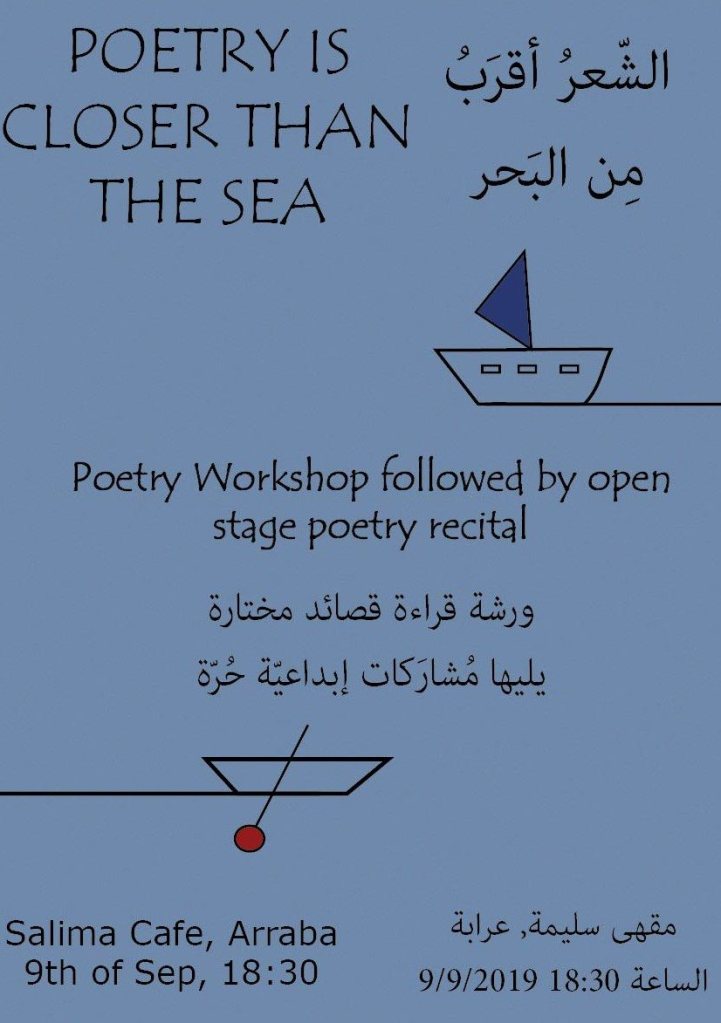
I look back at this evening and I am filled with happiness and pride: the evening was successful. The audience was riveted, and had the chance to get lost in a less-stressful world of our reality. A world of rhymes, metaphors, interpretations, space to play and think. It was perfect. What added to the richness of this night are many things: first, the audience was diverse, including old and young, Christian Muslim and secular, persons from different villages and cities in the region. In addition, this is one of the first attempts to create cultural and artistic spaces and platforms outside of the known, famous centres such as the city of Haifa or Jaffa. This is one of the first attempts to bridge the gaps between the “not-cultured” village-dwellers and the intellectual scenes taking place in the cities. I can say for myself that I feel that this attempt reaped fruit: many people showed up and many people have asked for more events and nights like these. In addition, the librarian in our town has started an initiative to start a club for poets and writers in Arrabe. I think our evening has inspired such movement.
Last, I am grateful for everyone who took part of this and I’m looking forward to future events.







 Poetry is Closer than the Sea